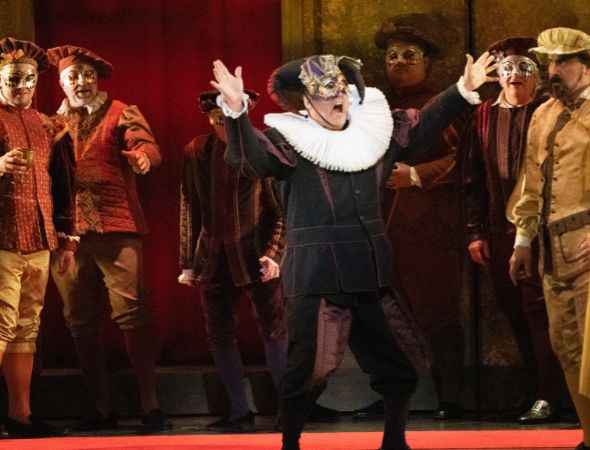
Rigoletto

By Giuseppe Verdi

Giuseppe Verdi’s enduring masterpiece was premiered in 1851 and is based on the Victor Hugo play, Le roi s’amuse. The project initially raised the eyebrows of the police censors in the commissioning city of Venice, but by the time word of this got to Verdi, he had found his muse and insisted on continuing. Further drama would soon ensue, pitting Verdi and his librettist against the will of “official opinion.” Luckily a compromise was reached, one that allowed Verdi to retain many essential story elements, most notably the iconic hunched back of the title character.

The action follows Rigoletto, a duke’s jester, whose insensitive mocking of another man’s anger earns him a curse and an eventual loss of horrific proportions. Rigoletto is both contributor and victim to the opera’s proceedings and, in the end, suffers most as a result of the complications that come from a life in service to an awful man, who reserves even the opera’s most famous music for himself.


Additional Info

Buy Now | Capitol Theatre | Saturday, January 21, 2012 7:30 PM
Buy Now | Capitol Theatre | Monday, January 23, 2012 7:30 PM
Buy Now | Capitol Theatre | Wednesday, January 25, 2012 7:30 PM
Buy Now | Capitol Theatre | Friday, January 27, 2012 7:30 PM
Buy Now | Capitol Theatre | Sunday, January 29, 2012 2 PM
Student Ticket Policy: Student tickets are available for students to attend Utah Opera performances at a more accessible price. For convenience, two student tickets can be purchased per student ID. The student ticket price is available only in select seats at Capitol Theatre. You will need to show a valid student ID when picking up or purchasing tickets.

Student Single Tickets
Student tickets are available for this performance in advance for $10 and on the day of the performance for $15. Please enter promo code “student” on ArtTix.org, call 801-355-ARTS (2787), or visit any ArtTix outlet.

Student Design-A-Series
Students who attend four or more Utah Opera or Utah Symphony performances during 2011-12 season can receive special benefits by purchasing a Student Design-A-Series. Benefits include student tickets for performances where they are not normally available, free ticket exchanges, waived phone and counter fees, and invitations to events where you can meet Utah Symphony musicians. Subscribe online or call Patron Services at 801-533-NOTE (6683).

Opera-tunities
Junior and senior high school students with their teachers are invited at a minimal charge to attend final dress rehearsals of main stage Utah Opera productions on the Thursday before Opening Night in Salt Lake City's Capitol Theatre with events running from 7-10 PM. For more information, please visit www.usuoeducation.org.

Age Policy
This performance is recommended for audience members who are eight and older. No infants or babes in arms.

Learn more about the Utah Opera's student discount program
The Duke of Mantua, Robert McPherson
Rigoletto, Guido Lebron
Gilda, Celena Shafer
Giovanna, Sishel Claverie
Sparafucile, Eric Jordan
Maddalena, Kirsten Gunlogson
Count Monterone, Gregory Pearson
Marullo, John Buffett
Matteo Borsa, Andrew Penning
Count Ceprano, Tyler Oliphant
Countess Ceprano, Jennie Litster
Page to the Duchess of Mantua, Raina Thorne

Director, Tara Faircloth
Conductor, Robert Tweten
Chorusmaster, Susanne Sheston
Costume Designer, Susan Memmott Allred
Lighting Designer, Nicholas Cavallaro
Musical Preparation, Carol Anderson
Act 1
During a ball at his palace, the Duke of Mantua tells of his designs on a beautiful girl he has seen in church. Then, admiring Count Ceprano's wife, the Duke rejoices in the beauty of women and his libertine hedonism (''Questa o quella''). When the Duke's flirtatious dance with Countess Ceprano draws the couple into another room,  Rigoletto, the court jester, mocks the woman's enraged but helpless husband. The nobles, delighted by the Duke's daring, are even more amused when Marullo bursts in with the latest gossip: Rigoletto is keeping a young mistress. The jester has been so free with his jibes that Ceprano plots with other courtiers to punish him. Monterone, an elderly nobleman, forces his way in and denounces the Duke for seducing his daughter. Ridiculed by Rigoletto, Monterone hurls a father's curse at both jester and Duke.
On the way home that night,  Rigoletto broods over Monterone's curse. Sparafucile steps from the shadows, offering his services as an assassin. The jester dismisses him, reflecting that his own tongue is as sharp as any murderer's dagger (''Pari siamo!''). As he enters his courtyard, Gilda, his daughter, comes out of the house to greet him. When she asks about her long-dead mother, Rigoletto describes his wife as an angel (''Deh, non parlare al misero''), adding that Gilda is everything to him. But he will not reveal his name or allow her to leave the house except to go to church. Rigoletto warns the housekeeper, Giovanna, to admit no one (''Ah! veglia, o donna''). He runs into the street when he hears someone at the gate; at the same moment, the Duke, in disguise, slips into the courtyard, bribing Giovanna to keep her quiet. The Duke declares his love to Gilda, who has noticed him in church (''È il sol dell'anima''). He says he is ''Gualtier Maldè,'' a poor student. At the sound of footsteps -- Ceprano and Borsa are rallying courtiers outside -- Gilda begs him to leave, and they exchange excited goodbyes (''Addio, speranza ed anima!''). Repeating his name (''Caro nome''), Gilda goes up to bed. Meanwhile, the courtiers stop Rigoletto and ask him to help abduct Ceprano's wife, who lives across the street. The jester is duped into wearing a blindfold and holding a ladder against his own garden wall while the courtiers break into his house (''Zitti, zitti'') and carry off Gilda. When Rigoletto hears her cry for help, he tears off the blindfold and rushes in. Not finding Gilda, he remembers Monterone's curse (''Ah! la maledizione!'').

Act 2
In his palace, the Duke is distraught over the kidnapping of Gilda, whom he imagines alone and in tears (''Parmi veder le lagrime''). When his courtiers return, saying they took her and she is now in his chamber, he dashes off to the conquest (''Possente amor mi chiama''). Soon Rigoletto enters, searching for Gilda. Though the courtiers are astonished to learn she is his daughter, they bar his way. He lashes out at their cruelty, then weeps for mercy (''Cortigiani! vil razza''). Gilda appears and runs in shame to her father. Alone with Rigoletto, Gilda tells of falling in love at church, of the Duke's courtship, of her abduction (''Tutte le feste al tempio''). When Monterone is led through on his way to the dungeons, Rigoletto declares he will avenge them both (duet: ''Siì, vendetta'').

Act 3
Rigoletto and Gilda wait outside the inn where Sparafucile and his sister, Maddalena, live. Rigoletto makes Gilda look through an opening in the wall. She sees the Duke, disguised as a soldier and laughing about the fickleness of women (''La donna è mobile''), trying to seduce the assassin's sister. Rigoletto cautions his daughter and plots revenge, as Maddalena draws out the libertine (quartet: ''Bella figlia dell'amore''). Telling Gilda to dress as a boy, the jester sends her to Verona, then pays Sparafucile to murder the Duke and leaves. A storm breaks. Gilda returns to overhear Maddalena urging her brother to spare the stranger. Sparafucile agrees to substitute the next person who comes to the inn. Gilda, resolved to sacrifice herself, knocks at the door and is stabbed. Rigoletto returns to claim his prize -- only to hear his supposed victim singing in the distance. Frantically opening the sack, he finds his daughter. Gilda dies asking forgiveness.